
“Nothing can now be believed which is seen in a newspaper. Truth itself becomes suspicious by being put into that polluted vehicle…I will add, that the man who never looks into a newspaper is better informed than he who reads them; inasmuch as he who knows nothing is nearer to truth than he whose mind is filled with falsehoods & errors.”
— Thomas Jefferson, 1807
It may be some comfort to know that disillusionment with the media is nothing new. But while scepticism has always existed, the scale of the current crisis is arguably without precedent. The technology that exponentially amplified the reach of media has exacerbated old problems and created entirely new ones.
The foundation of any healthy society is the ability to understand what is happening in the world. It is the basis for informed decisions, both individually and collectively. Outside of our own senses, our primary vehicle for becoming informed about the world is the media. But trust in that institution has collapsed.
Surveys consistently show that public trust in news organizations is at historic lows. Even those numbers may be inflated; much of that remaining ‘trust’ could be from audiences being content in having their pre-existing biases confirmed.
The biggest change has been the rapid advance of information technology. The internet and smartphones have given the public unprecedented access to information, allowing anyone to bypass the editorial lens of traditional media. Raw interviews. Unfiltered footage. Direct communication between public figures and the public. The old gatekeepers no longer hold all the keys. And with this access, the public has seen for themselves the extent to which media can mislead and distort reality.
We’ve moved from broadcasting to narrowcasting. Where media once aimed for broad, balanced reporting to inform an entire nation, the rise of alternatives has created market pressure to tailor content to specific market segments. This may better appeal to audiences in various ideological or cultural niches, but at a cost: polarization.
When media outlets rely on niche audiences, they become captive to their expectations. Unless they conform to the narrative their audience wants to hear, they will lose them to another outlet. Reality includes some bitter pills that people should still swallow, even if they aren’t their preferred taste.
Much of this is a problem that media outlets have created for themselves. Modern journalism often has been shown to use deceptive framing, take quotes out of context, or spread misinformation. The result is a media landscape where the line between reporting and manipulation grows ever more blurred.
One telling example: the viral montage of dozens of local news anchors, across supposedly independent outlets, all reciting the exact same scripted warning about “fake news.” It laid bare just how little editorial independence many outlets actually have.
And when the facts turn out to be wrong, whether it’s misreporting a major story, slandering an innocent person, or pushing a politically convenient lie, what happens? Often, nothing. No apology. No correction with equal prominence. No introspection. No accountability.
Too often once-respected media institutions act little better than tabloid magazines predicting a celebrity divorce for the 42nd time. And yet, these same outlets still present themselves as arbiters of truth.
All of this leaves audiences in a dangerous position; unable to know who to trust, and worse, whether “facts” even matter to the media anymore. After all, the 2016 Oxford Dictionary Word of the Year was “Post-Truth.”
Much of this decline is structural. The rapid advances in information technology have led to the collapse of traditional revenue streams, especially advertising. Media companies, facing economic pressure, have gutted newsrooms and prioritized quantity over quality.
Deep investigative journalism, the kind that once earned public trust, has been sacrificed at the altar of engagement. Outrage gets more clicks than nuance. Reporters are expected to produce more, faster, and with fewer resources.
It is not enough to abandon rotten institutions. What will replace them? As Aristotle warned, “Nature abhors a vacuum.” If we do not build something better, the same problems will emerge in new forms. How do we ensure what comes next is any more trustworthy?
To restore trust in media, both new and old, it must earn that trust. We must have a system that rewards them for doing so.
Others have documented these problems in far more depth and detail than I can here. But I’m not trying to add another voice to that commentary. As a tech entrepreneur, I’m here to help build the solution.
The Solution: Media Health Check
A system designed to hold media accountable like never before, raising the bar for accuracy, transparency, and public engagement.
On the homepage of HealthyDebate.org, users can easily search for any one article, video, podcast, or speech among millions. From any source, on any topic. Once chosen, every claim made can be identified and assessed within the HealthyDebate framework.
How It Works:
The Media Health Check employs a rigorous, AI-assisted, process:
- Media content is parsed to identify each claim made, presented in clear neutral language. HealthyDebate will apply a ‘materially similar’ test to ensure equivalent claims aren’t duplicated under slightly different phrasing.
- Sources are contacted to confirm that this is a fair representation of their claim and are invited to submit what evidence they have to support it.
- Each claim will be linked to the one definitive debate over it. Here, the one making the claim has the opportunity to defend or clarify their position by contributing to either side of the motion. This fosters an unprecedented level of accountability and invites engagement. It offers a level of depth that no existing media format can match.
- HealthyDebate seeks permission to reproduce the full text or transcript of media content. If permission is denied, only the extracted claims will be listed. Sources that decline participation may simply be marked with: “This source declined to participate”, a subtle but powerful prompt toward accountability. Public domain content can be used in full without any such restriction.
Unlike traditional fact-checking platforms that position themselves as final authorities, yet may themselves be biased or flawed, HealthyDebate creates a competitive arena for seeking truth. Claims and counterclaims are assessed side by side, and the fact-checkers can be fact-checked in turn, in the very same space where the original information is consumed.
A correction that arrives years later, on a platform the original audience never sees, is not accountability. True accountability must be timely, visible, and accessible. That’s exactly what HealthyDebate makes possible.
HealthyDebate’s Media Health Check is not just a tool. It’s a collective movement to elevate public discourse by:
- Building a shared effort to verify claims, so readers don’t have to chase down every source themselves. Think X’s Community Notes on steroids, but with open debates and source accountability
- Incentivising media, politicians, and institutions to back up their statements.
- Giving trustworthy sources a unique opportunity to demonstrate rigour, show transparency, and rebuild trust.
- Fostering civil debates based on shared facts that break echo chambers and build common ground.
- Enabling everyone to engage in meaningful discourse and contribute to higher standards.
The Roadmap
HealthyDebate.org is a not-for-profit organization, incorporated in Delaware for First Amendment protections. It will apply for 501(c)(3) status so that donations are tax-deductible. And it will be crowdfunded — to avoid even the perception of capture by special interests.
Impartiality is more than a principle. It’s a strategic necessity.
If we want everyone at the table, we have to build something that earns their trust.
The public crowdfunding campaign hasn’t yet launched, that is intentional.
“Victorious warriors win first and then go to war, while defeated warriors go to war first and then seek to win.” — Sun Tzu
People are far more likely to support a mission that has momentum, credibility, and leadership behind it.
So before going public, the focus is on building a solid foundation by:
- Securing endorsements from respected voices across the political spectrum.
- Involving people with a proven track record managing successful ventures.
- Engaging influential voices who can help amplify the message.
Whether that means donating, constructively critiquing, or getting involved, every contribution counts.
But most importantly: Please share this. It’s the only way a spark becomes a wildfire.
Or at the very least, prepare your arguments. The debates that shape the future are coming.
Be part of the solution. Be seen to be part of the solution.
Support HealthyDebate.org
A picture says a thousand words.
To reveal how HealthyDebate will look and function, the following is a small selection from over 100 pre-alpha designs.
Media Health Check
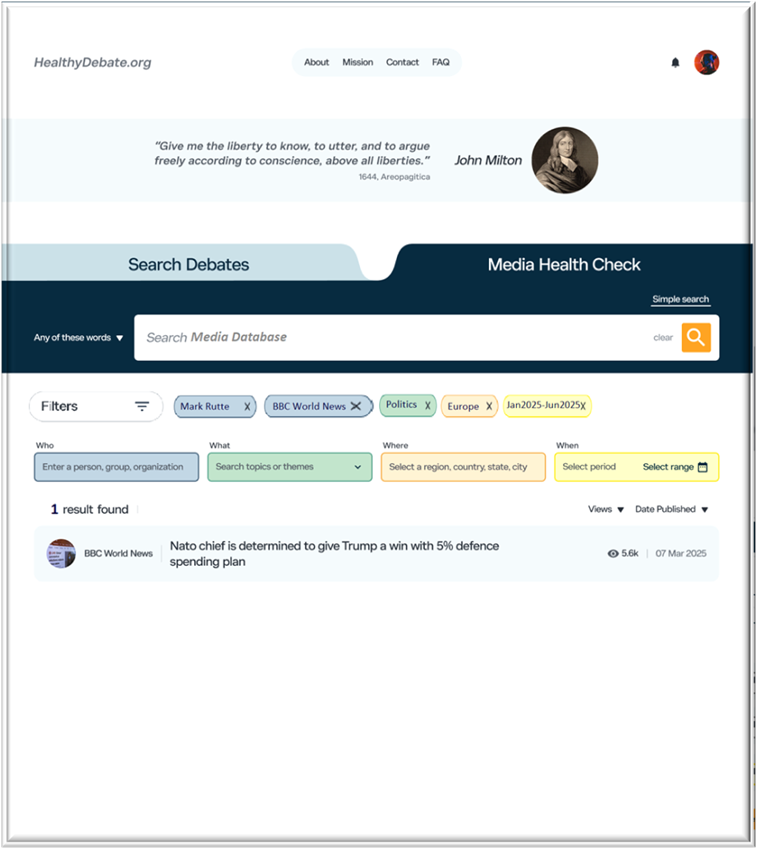
Advanced Search: Media Health Check
Instantly find a single article, speech, or video among millions.
AI-assisted tags filter by who, what, where, and when.
Sort results by views or date published.
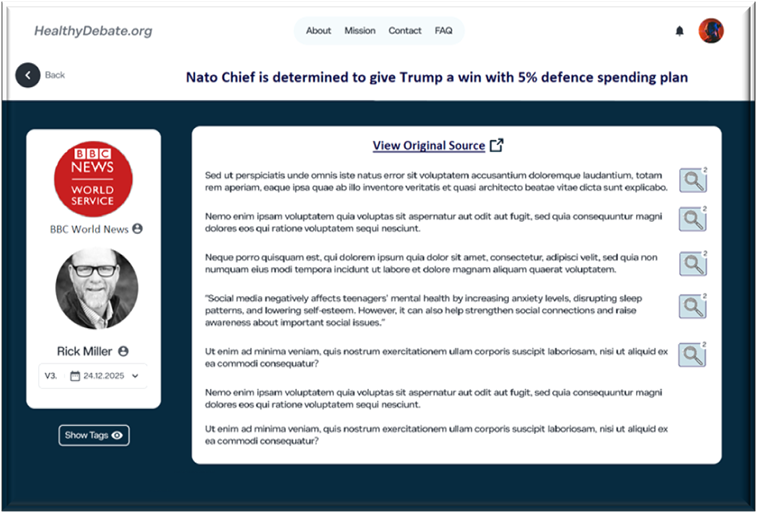
- Link to the Original Article.
- View the profile and articles of the Media Organisation.
- View the profile and articles of the individual author.
- The article, or at least the claims within it, assessed within the HealthyDebate framework.
Each Claim Identified
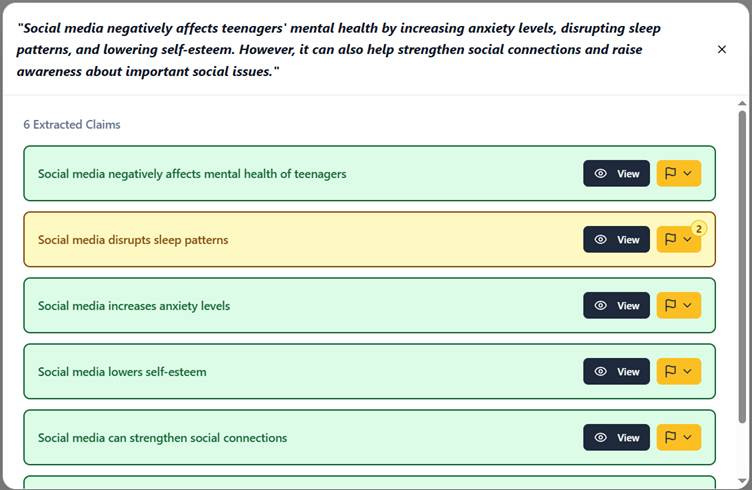
- With AI assistance, the number of claims made within each paragraph are identified in neutral language.
- Colour coded, green for unchallenged. Yellow for debated. Red for accepted as false.
Possible to view:
- The Supporting evidence for each claim.
- The Challenges to each claim.
- Who else has made that claim.
Challenges
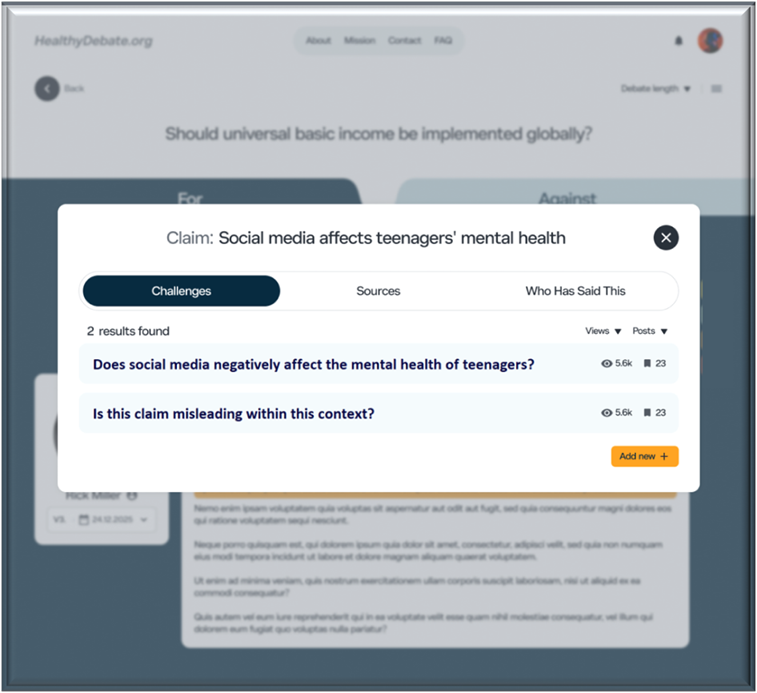
- link to the one definitive debate over that claim.
Sources
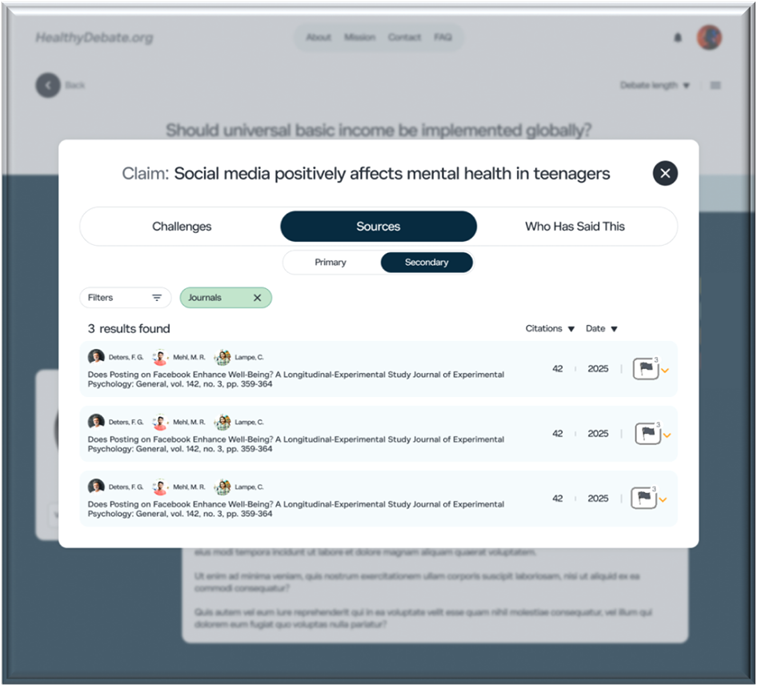
- Divided between Primary and Secondary.
- Advanced Filters, with AI assisted tags, enable the user to filter the list of sources.
- Sources can be sorted by number of citations and by the date published.
- The reliability and relevance of each source in supporting this claim can be debated in turn.
Who Has Said This
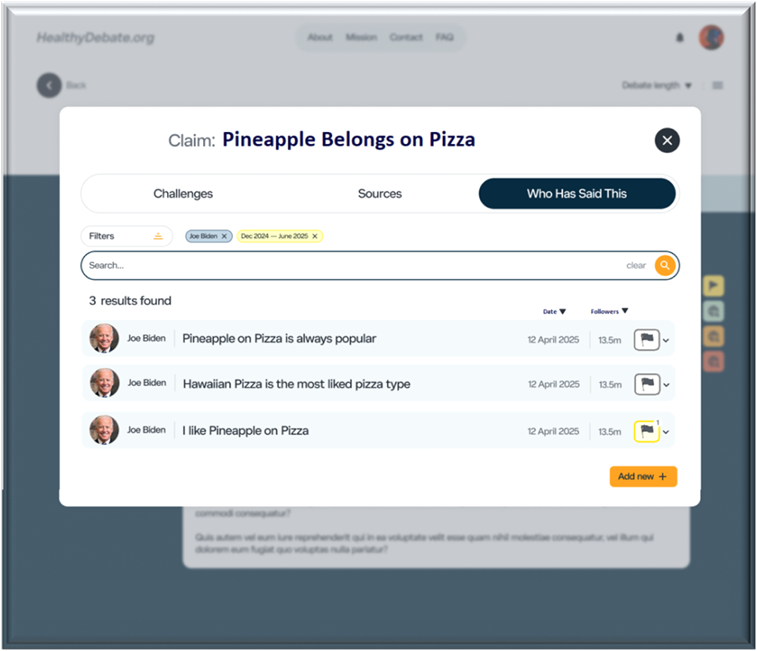
Note: This is a hypothetical example. I am unaware of Joe Biden’s stance on pineapple on pizza.
- Trace the spread of ideas by seeing who else has made this claim.
- Instantly find a single claim among millions.
- AI-assisted tags filter by who, what, where, and when.
- Sort results by when the claim was made, or by followers.